The excavations in Naantali in the summer of 2005
The Naantali churchyard and the adjacent park hide one of
the most
important historical monuments in Finland – a medieval Brigittine
monastery.
The monastery was in it’s time divided in two separate sections;
one for the
nuns, the other for the monks. The nun’s section was located on
the northern
side of the church. The heaps of it’s ruins are partly preserved
under the
trees in the park, next to the fenced excavation area.
The
2005 excavations take place in the location of the future urn
cemetery. The excavations will most probably continue for the entire
summer.
The work is funded by the Naantali congregation, supervised by the
National
Board of Antiquities and the actual excavations are performed by
Muuritutkimus
Ky, an archaeological research company. The researchers of the company
have
excavated in different locations in the old town area for the past nine
years.
The present research is one of the most extensive urban archaeological
excavations in recent years.
The
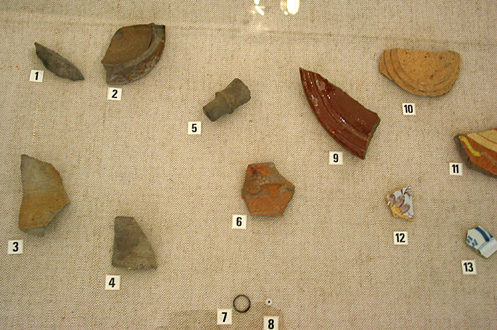
excavations have hitherto revealed two time-stratigrafic levels. In
the area adjacent to the churchyard and the church finds related to the
everyday life in the monastery have been found, i.e. fine imported
german
ceramic ware and leftover bones of domestic animals. The area may have
been the
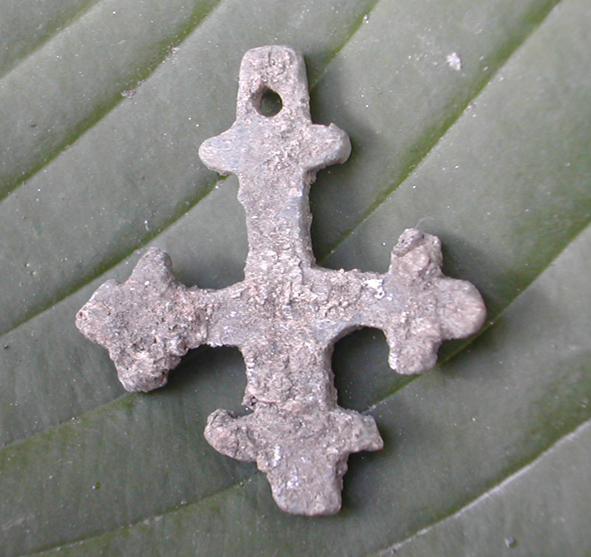
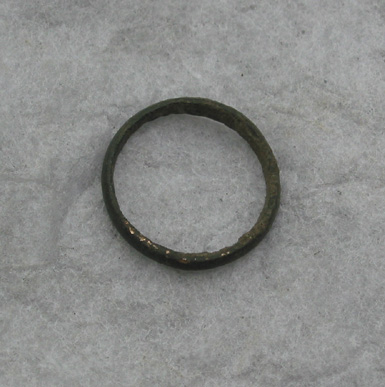
backyard of the monastery kitchen. A ring, a small decorative cross and
a pearl
of glass were also found in the area. The excavation is traversed by a
SE –
NW-striking stone paving, which may be a part of the monastery’s
outer fence or
possibly related with the later rectory.
The
second level was revealed close to the gate of the present cemetery,
next to which a 17th century layer of fill earth with
adjoining
remnants of building foundation rocks was excavated. The fill earth
layer was
rich in finds; approximately 1000 large and small objects were found,
the
largest an almost intact cast iron frying pan and among the smallest
five or
six silver- and copper coins dated to the 16th and 17th
centuries. Both the foundation rocks and the thick fill earth layer are
related
to the 17th century rectory in the area.
The
most interesting finds are exhibited at the Naantali Museum, the
“Hump” building in the old
town, and you
may also ask any relevant questions of the archeologists and students
working
on the excavation. Updated information regarding the excavations can
also be
found at www.muuritutkimus.com.
Copyright ©
Muuritutkimus ky 2004- | Päivitetty: 1.1.2004 | Ylläpito: Kari Uotila
URN:NBN:fi-fe20041467
Design: Isto
Vatanen